Find the damaged upright before the load does.

Racking, materials handling equipment and dock infrastructure on one system inspected at the bay, evidenced with a photograph, and tracked until somebody actually fixes it.


Logistics_Warehousing_Hero_Square

THE COMPLIANCE REALITY

For distribution centres, keeping up with statutory obligations and compliance requirements is a job in itself.


Every truck has a thorough examination cycle and a pre-use check. Every run of racking has an inspection regime and a damage classification. Dock levellers, shutter doors, mezzanine gates, fire systems, emergency lighting, each on its own schedule, most of them checked by someone whose actual job is moving pallets.

The obligations aren’t the hard part. The hard part is that a warehouse looks fine right up until the moment it doesn’t, and the record of what was found last quarter is on a clipboard in the office.

Across the warehouse

  • Materials handling

    Counterbalance and reach trucks, VNA, order pickers, pallet trucks. Examination cycles, pre-use checks every shift, and operators who need the check to take a minute rather than five.

  • Racking and storage

    Uprights, beams, bracing, mezzanines, pallet gates. Thousands of near-identical components where the damage that matters is on one of them.

  • Dock and building

    Levellers, shelters, shutter doors, restraints, lighting, fire systems. The equipment that stops the site when it fails and rarely appears on anyone’s asset register.


Two hundred bays passed. One didn’t. That’s the one that matters.

Racking inspection is the clearest case for checkpoint-level records anywhere in this business. An aisle walk covers hundreds of near-identical components, almost all of them fine, and the entire value of the exercise is the two or three that aren’t.

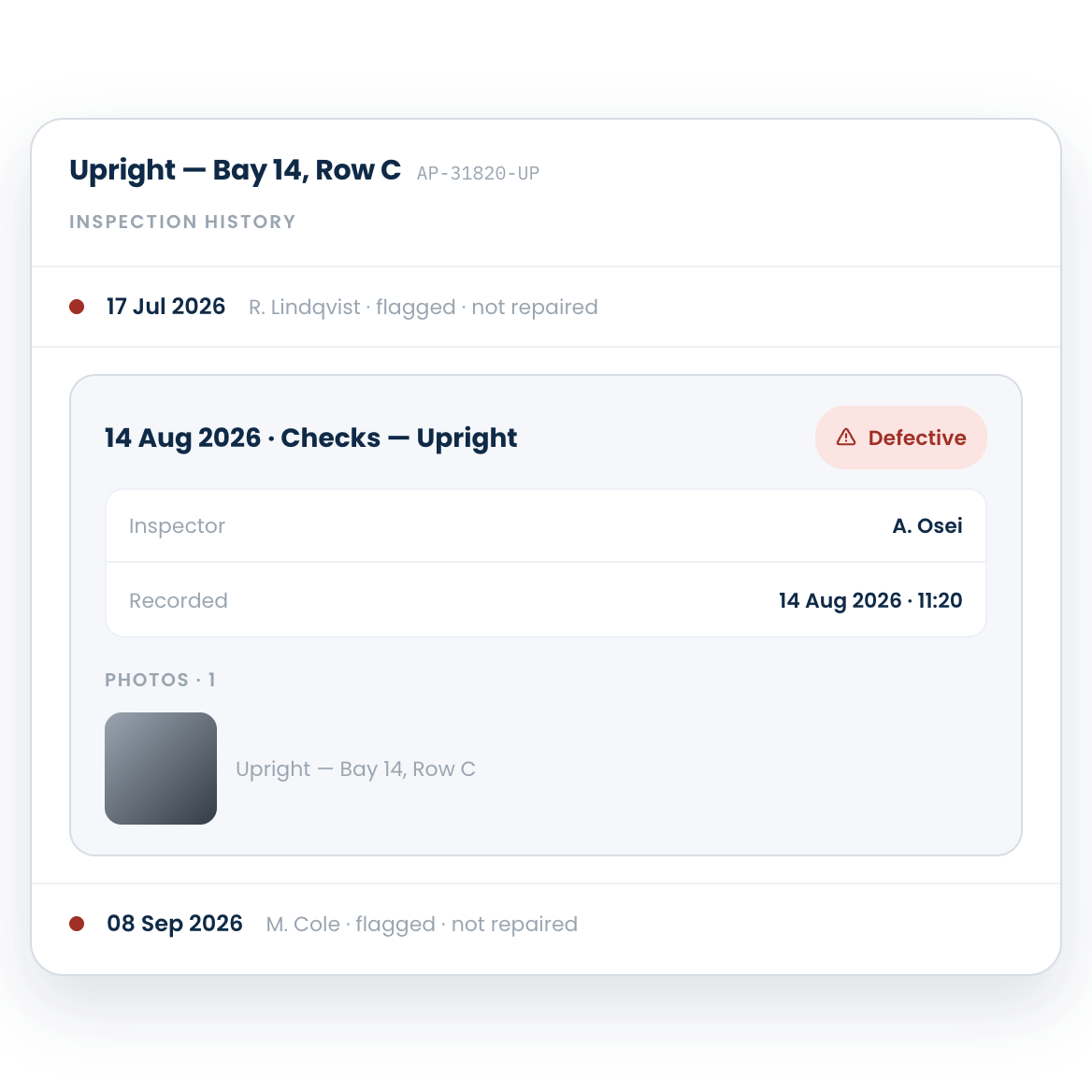
Your inspectors already classify damage by severity. Nova keeps each classification against the specific component, with the photograph, and holds it there until that component is re-inspected and passes.

  • Every component recorded individually, not as an aisle result
  • Damage classification held against the specific upright or beam
  • Photo evidence attached to the component
  • A flagged component stays flagged until it’s re-inspected and passes
  • Repeat damage in the same location becomes visible over time
Logistics_Warehousing_Component_Timeline_Square

Sixty trucks, three shifts, every day.

Pre-use checks are one of the highest-volume inspections in a building, and they’re also one of the easiest to turn into a box-ticking exercise. When a five-minute check is done on a clipboard at the start of a shift, it’s tempting to sign it off rather than actually complete it.

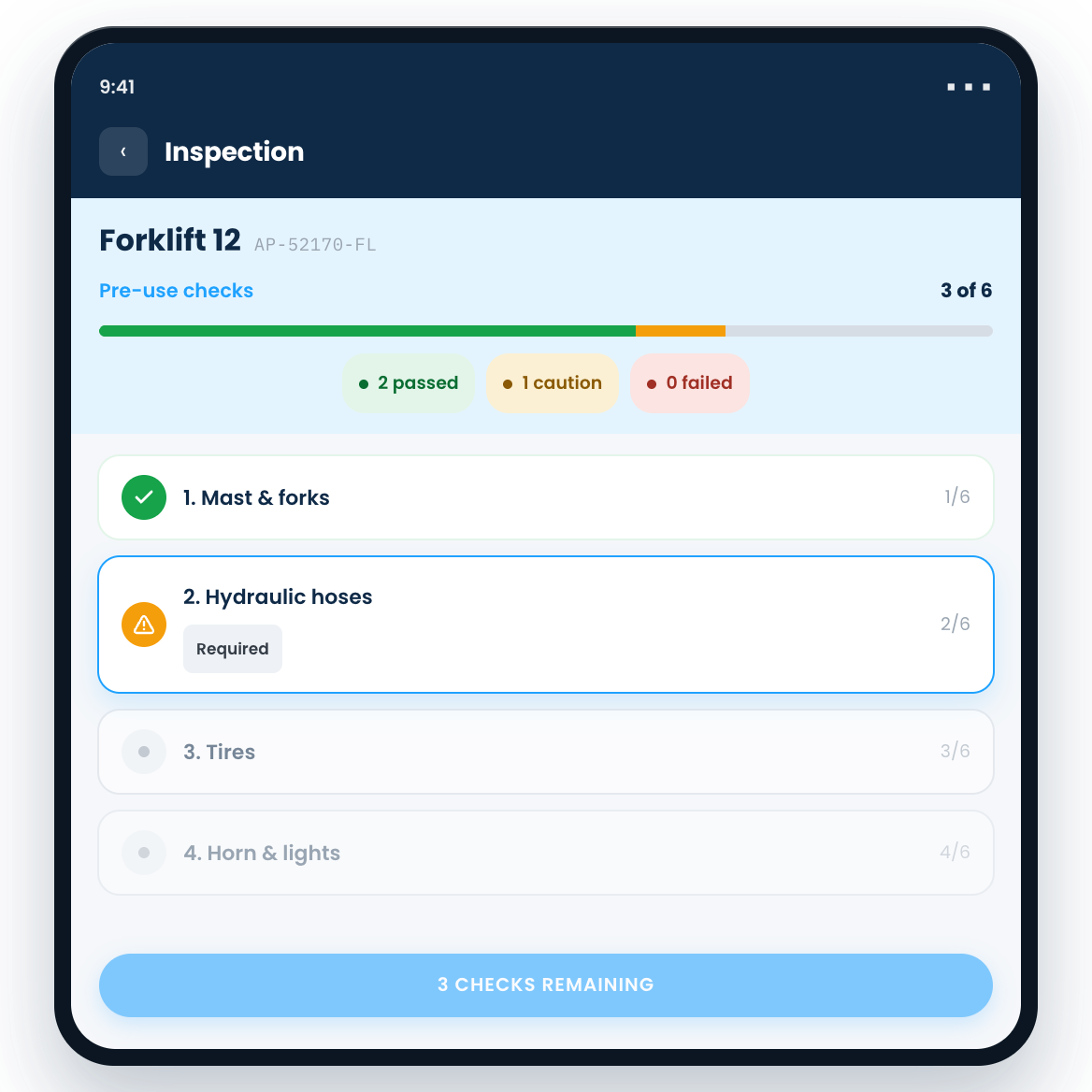
With AssetPool, checks are set up once for each truck type and then applied to every unit. The operator opens the truck they’re using and sees only the checks relevant to that specific vehicle. Any issues or findings are recorded directly against the same asset record the engineer sees, instead of ending up on a piece of paper in a tray.

  • Checks defined per asset type, applied across the fleet
  • Offline capture on the floor, from the Essential plan
  • Findings attributed to the operator who recorded them
  • Full history per truck across every shift it’s run
  • Real-time sync between mobile and web
Logistics_Warehousing_Preuse_Check_Square


Running fine is not the same as safe to load.


A reach truck can be mechanically perfect and past its examination date. A rack run can be inside every inspection cycle and carrying a damaged upright somebody classified last month. Both look fine on a summary.

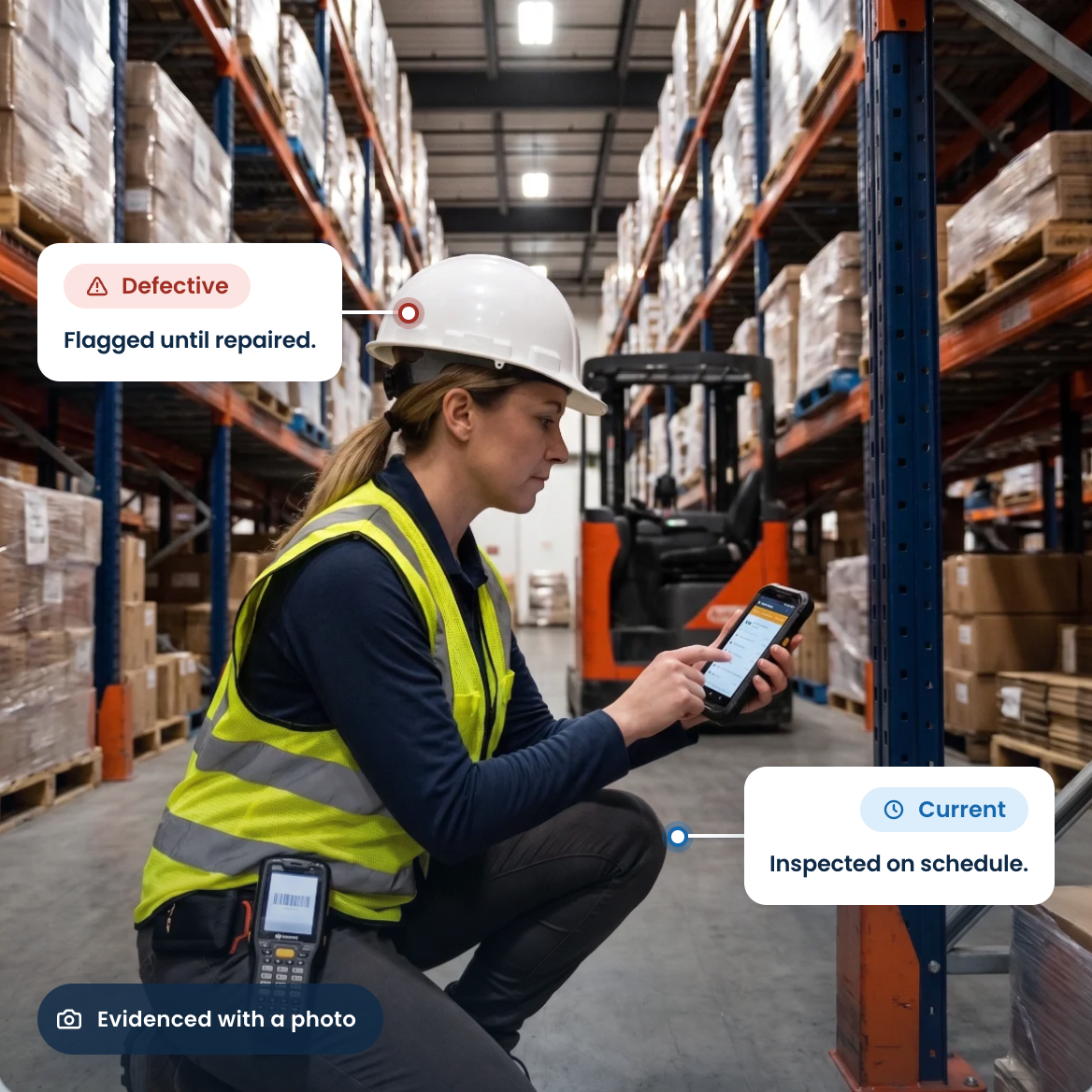
Take that rack run. Condition: Defective — one upright is flagged and hasn’t been re-checked. Compliance: Current — the inspection regime is being followed exactly as scheduled. Risk profile: Critical — it’s a high-bay run carrying full pallets over a pick face.

Compliant and defective at the same time, which is precisely the combination a single score hides.

Logistics Industry Testimonials

  • By adopting AssetPool’s digital inspection software, DHL has transformed its vehicle inspection process, leading to improvements in vehicle safety, driver compliance, and fleet management. The result is a more efficient, compliant, and cost-effective operation that enhances both safety and productivity across their delivery network.
    dhl


  • "Assetpool is a very easy tool to use! The support is always a finger tip away and they are always available so you never struggle with queries."

    takelaot

    Lu-Ashlin

    Take Alot.

Frequently asked questions

Do you handle driver walkaround checks and DVIR?

Nova runs any inspection you can express as a checklist, including a walkaround. What it isn’t is a fleet compliance platform — there’s no telematics, no electronic logging and no driver hours. If that’s what you need, a dedicated fleet system will serve you better, and Nova sits alongside it for the warehouse and yard side.

Can we inspect racking down to individual bays?

Yes, and it’s the reason the model works this way. Each component is its own record with its own history, so a flagged upright stays flagged until that upright is re-inspected — it isn’t cleared by the aisle passing next quarter.

Can operators complete pre-use checks quickly?

The check list is defined per truck type, so an operator sees only what applies to the machine they’re on.

 
Does it work on the warehouse floor without a signal?

Offline capture is available from the Essential plan. Checks complete on the device and sync when it’s back in range — useful in high-bay and chilled areas where coverage is unreliable.

 
We run twelve sites. How does that work?

Essential covers 150 locations and 20,000 assets. Networks running pre-use checks across multiple sites and shifts generate volumes above the published plans and are priced individually, worth a conversation rather than a sign-up.

 
Can we show an auditor what was found and when?

Every finding is on a searchable record with photo evidence attached to the specific component, viewable on screen at any time.


Start with one aisle.

Free forever on the starter plan. Put one rack run and a handful of trucks in, and see what a component-level record looks like.